

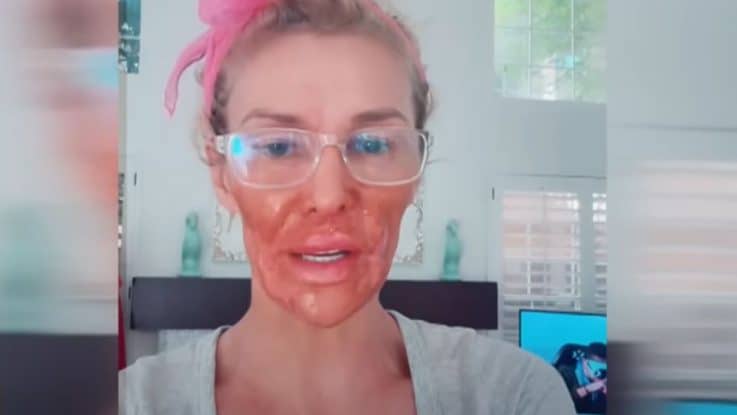
In front of millions of people, Brandi Glanville’s face has become an uncensored record of tenacity, bewilderment, and perseverance. Previously praised for her impressive red carpet presence, she now opens up about a mysterious illness that has changed her look and, in many respects, her life. When she was diagnosed with stress-induced angioedema, a condition that causes abrupt swelling, the change started in the middle of 2023. Her symptoms changed over time, including a series of painful lumps along her jaw and neck, persistent swelling on one side, and facial sinking.
Her public updates have become increasingly detailed in recent months, detailing what she describes as “tiny bubbles bursting” beneath her skin. She blames these symptoms on a possible parasite she caught while filming Real Housewives Ultimate Girls Trip in Morocco. The allegation is based on meals that were left out of the refrigerator for hours during production—a fact that, when made public, captivated fans and sparked a heated discussion. She even gave the supposed parasite the name “Caroline,” after her rival on screen, Caroline Manzo, in reference to her past on reality TV.
Brandi Glanville – Profile
| Attribute | Details |
|---|---|
| Full Name | Brandi Lynn Glanville |
| Date of Birth | November 16, 1972 |
| Birthplace | Salinas, California, USA |
| Height | 5 ft 10 in (1.78 m) |
| Occupation | Television Personality, Author, Former Model |
| Known For | The Real Housewives of Beverly Hills, Celebrity Big Brother, The Traitors |
| Children | Two sons |
| Health Concern | Facial disfigurement linked to suspected infection or reaction |
| Estimated Medical Costs | Over $70,000 spent on treatments and diagnostics |
| Notable Media Moments | Nair incident, public TikTok health updates, reality TV appearances |
When Glanville shared a TikTok showing that she had used the chemical hair removal cream Nair on her face, the story went viral. The parasite was sufficiently agitated, according to her, to “move,” but the visible burns and angry redness that followed told a different tale. Fans and medical professionals expressed a great deal of concern after her humorous remarks about the incident, with many cautioning against using such products on sensitive facial skin.
Her medical experience has been expensive and draining. She has sought advice from rheumatologists, immunologists, infectious disease specialists, and renowned plastic surgeon Dr. Terry Dubrow, who conducted several biopsies. Dubrow has openly challenged the parasite theory, arguing that a persistent bacterial or fungal infection—possibly from previous cosmetic injections—is more likely to be the cause. He points out that these conditions can be obstinate, requiring focused treatment for six months to a year, and that delaying treatment could result in permanent scarring.
Glanville is adamant about exploring every option in spite of these viewpoints. She has undergone multiple lab tests, dissolved all fillers, and tried a variety of drugs, from antifungals to antibiotics. Some regimens provided short-term relief, at one point making her look nearly “normal,” but their expense was unaffordable, so she had to stop. She has since given credit to Dr. Michael R. Scoma of New York, who hinted at progress but withheld specifics until tests were finished, for demonstrating a sincere dedication to finding answers.
She is both vulnerable and strong because of her openness. Being in the spotlight means that every outburst, advancement, or failure is examined through the eyes of paparazzi and online commentary. The emotional toll is increased by the unrelenting attention. She has acknowledged experiencing times of intense sadness, loneliness, and annoyance—not only because of her illness, but also because of the protracted medical process.
Additionally, this story has shed light on a larger discussion concerning public health narratives, cosmetic culture, and celebrities. Glanville’s readiness to share her journey challenges the convention that many people in the entertainment industry keep such hardships confidential. In a time when health claims can spread more quickly than they can be verified, her posts, which are occasionally honest and self-deprecating, inspire empathy while simultaneously provoking skepticism.
Her case raises questions about how society perceives credibility, illness, and beauty. She is viewed by some as a warning about the dangers of unproven therapies and by others as a testament to perseverance in the face of unrelenting hardship. Her story, which is based in human vulnerability but is magnified by the very machinery of fame, is made especially compelling by the combination of her legacy from reality TV and this unvarnished health battle.
Glanville adds a glimmer of hope even in her most depressing updates. She talks about wanting to “live again”—to straighten her teeth, put on weight, and face life with the same candor that she has displayed during this ordeal. By doing this, she changes the focus of her story from illness to reclamation, implying that even though recovery is uncertain, it is still very much possible.
Her face, which has changed over time due to swelling and treatment, now conveys more than just the tale of a possible parasite. It describes a woman who, in the face of constant public scrutiny, faces both emotional and physical struggles and, amazingly, decides to continue narrating that story in her own words. If a resolution is reached, it will demonstrate her tenacity as much as medical science, and it might serve as a reminder that openness, even in its most clumsy form, can have surprisingly potent effects.
Leave a Reply