

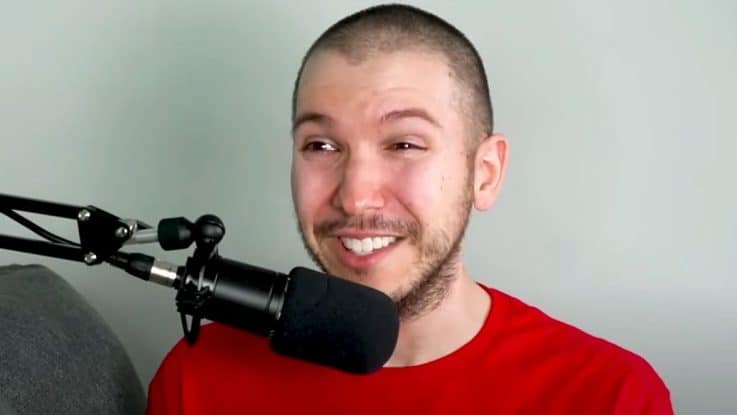
Once notorious for his tumultuous outbursts and frantic mukbangs on TV, Nikocado Avocado shocked his audience by revealing that he has shed more than 250 pounds. He weighed almost 400 pounds at his height, a weight that had come to define his public persona. Nicholas Perry, however, was precisely altering his image and his health in private as millions of people laughed or worried over his seeming decline.
He created the appearance that his previous life was unaltered by pre-recording videos and disseminating them over a two-year period. He was able to recover from the public’s scrutiny thanks to this incredibly successful tactic. His supporters were only taken aback by the extent of his change when he reappeared with a smaller frame and a weight of only 158 pounds. By doing this, he regained control over both his body and the story that had been written for him by others.
Nikocado Avocado
| Category | Details |
|---|---|
| Real Name | Nicholas Perry |
| Stage Name | Nikocado Avocado |
| Profession | YouTuber, Online Personality |
| Known For | Mukbang videos, dramatic online persona |
| Date of Birth | May 19, 1992 |
| Age | 33 (as of 2025) |
| Nationality | American (born in Ukraine, raised in the U.S.) |
| Height | 6 ft (183 cm) |
| Peak Weight | ~411 lbs (186 kg) |
| Current Weight | ~158 lbs (72 kg) |
| Total Weight Loss | Over 250 lbs (114 kg) |
| Weight Loss Methods | Healthier diet, staged video strategy, skin removal surgeries |
| YouTube Subscribers | 4.6 million+ |
This attitude of defiance was reflected in his video, Two Steps Ahead. According to Perry, the project was a social experiment meant to show how people’s perceptions altered as his body changed. The message was very clear: he maintained that there was always control even when fans witnessed mayhem. While Perry’s version was broadcast in real time, or at least what appeared to be real time, it was remarkably similar to the way actors like Christian Bale or Jonah Hill have stunned audiences with startling physical transformations.
There were additional elements of curiosity because his travel was covert. He said that in order to avoid public recognition, he had shaved his head, angled his camera precisely, and concealed loose skin during previous appearances. He later had procedures to remove more than 10 pounds of extra skin, and he openly described the difficult recuperation as feeling like an orange that had been “sawed in half.” Viewers were moved by this candor, especially those who realized that drastic weight loss frequently entails both physical hardships and victories.
His argument was particularly novel since it conflated authenticity and performance. Excessive food, excessive emotions, and excessive spectacle had all been key components of Perry’s profession. He went through another drastic weight loss, but this time it significantly increased his longevity and health. His tactic demonstrated how artists may control perception while yet retaining or even expanding their fans in the context of online culture.
Transformations have grown ingrained in online culture during the last ten years. Chris Pratt, Adele, and Rebel Wilson all reinvented themselves and changed the public discourse. However, what makes Perry’s example unique is that it was both performative and personal—his admirers served as both the audience and the unintentional participants of his experiment. His comparison of his audience to “ants on an ant farm,” noting how they responded without ever realizing they were a part of the performance, was a particularly striking parallel.
Reactions to this disclosure were not quite uniform. While detractors accused him of using his weight as a political platform, supporters commended his self-control and tenacity. In a digital world where disagreement drives clicks, Perry seems at ease taking sides. Unquestionably, his experience has greatly lessened the taboo associated with talking candidly about the difficult realities of weight loss, including surgeries and fears.
However, there is a warning behind this. Perry questioned the commercialization of body image by using his health as a source of amusement. Concerns about quick cures and perfect bodies are reflected in the debate about whether he used drugs like Ozempic or if surgery was “cheating.” Given that the weight-loss business, which is worth billions of dollars, makes its living by marketing metamorphosis as a show, this question is especially pertinent.
Perry’s life after metamorphosis seems noticeably better, despite the criticism. He has changed his content in a very versatile way, posting fewer mukbangs currently. He produces content selectively, combining humor and thoughtful criticism, as opposed to uploading several times a day. A tone that feels more relaxed, healthier, and, in many ways, quite effective in preserving his body and his relevance has taken the place of the dramatic binge-eating episodes that once characterized his brand.
Internet stardom is as much a matter of perception as it is of reality, as his narrative demonstrates. Perry reminded millions of people that not everything they see online should be believed by crafting his metamorphosis into a cover story. His voyage has been characterized as a hoax and a victory in recent days, but it might be better viewed as an experiment in vulnerability and visibility.
Leave a Reply