

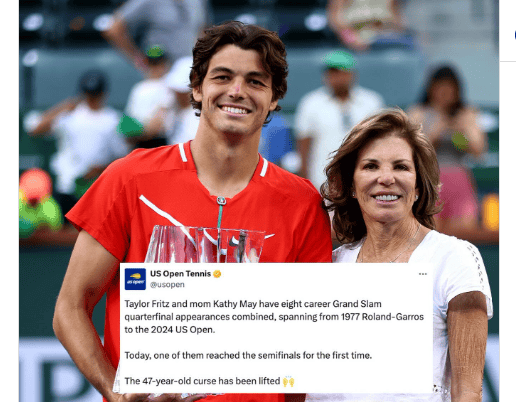
In a 2025 US Open Round of 16 match, Taylor Fritz defeated Tomas Machac in straight sets with remarkable control. However, many fans were abnormally fixated on the stands—more especially, on Fritz’s mother, Kathy May—while he maintained the concentration on his racquet. Due to rumors about her looks and whether or not she had plastic surgery, her courtside appearance caused an abrupt spike in online searches for “Taylor Fritz mom face.”
That conjecture, which was particularly stoked by online gossip sites and entertainment tabloids, implied that Kathy May might have chosen to undergo cosmetic surgery or a facelift. There isn’t any direct confirmation from May, though. No remarks, interviews, or public declarations. Her immaculate appearance in recent high-definition broadcasts sparked a fan-driven conversation. The rumor stays just that—rumor—in the absence of reliable confirmation. However, her amazing tennis history and continuing influence are far more significant than her polished appearance.
Kathy May – Career and Profile Summary
| Attribute | Detail |
|---|---|
| Full Name | Kathy May Fritz |
| Date of Birth | June 18, 1956 |
| Age | 69 (as of 2025) |
| Nationality | American |
| Profession | Former Professional Tennis Player |
| Highest Ranking | Top 10 (WTA, Late 1970s) |
| Career Titles | 7 WTA Singles Titles |
| Grand Slam Highlights | QF – French Open (1977, 1978), US Open (1978) |
| Notable Wins | Defeated Billie Jean King (3 times), Martina Navratilova (1977) |
| Famous Son | Taylor Fritz (American No. 1 Male Tennis Player) |
| Reference Source |
Kathy May was more than just an encouraging tennis mom who watched from the player’s box. She used to compete aggressively against well-known athletes like Chris Evert and Billie Jean King as a top-tier professional. She was ranked in the top 10 worldwide, something that very few American women have accomplished. Her triumphs weren’t accidental or the result of underdog tactics. They were earned. She actually defeated Billie Jean King three times, which is an achievement that not only merits greater recognition but also establishes her as one of the most subtly powerful athletes of her time.
Fans may be enthralled with Kathy May’s beauty these days, but her footwork and tactical acumen on clay were enthralling audiences back in the late 1970s. She made it to the quarterfinals of the French Open twice, and in 1978 she did the same at the US Open. In a field dominated by tennis greats, she frequently held her own during her career, which included seven WTA singles titles and frequent appearances at major tournaments.
Chris Evert herself gave one of the most poignant tributes, recalling her role as Kathy May and drawing a comparison between her tenacity and Taylor Fritz’s. “She was a great competitor… like mother, like son,” Evert wrote on social media. Fans who were familiar with both periods of American tennis found the connection especially poignant. It highlighted a particularly significant point: the Fritz family has a long history of athletic intensity.
Kathy May has helped Taylor through injuries, periods of low confidence, and the demanding ATP schedule by working closely with her son. She has provided information that only someone who has traveled that exact journey can offer, although not being in the official coaching box. Taylor’s psychological fortitude, which has been especially noticeable in his recent US Open results, was probably influenced by her experience.
Kathy May has had a very effective impact thanks to her astute parenting and thorough comprehension of the demands of professional sports. Taylor has a solid foundation that has been meticulously constructed and quietly maintained, as evidenced by his maturity, ability to focus under pressure, and gradual ascent up the ATP rankings. Even though it’s frequently unseen, that impact is especially helpful in a setting where many young athletes have trouble controlling their expectations.
Tennis families were pushed into more confined spaces during the pandemic, and many parents became even more committed. A constant throughout Taylor’s path was Kathy May. Her presence on the court is not merely symbolic; it is a component of a larger network of support that is especially creative in the way it combines the realities of contemporary tennis with the experiences of previous generations.
It may be reasonable for people to be curious about her face, but it shouldn’t take away from the poise and tenacity with which she has handled two tennis careers—her own and her son’s. Even if rumors of surgery are circulating, it’s very evident that she has matured gracefully and still carries herself with the same dignity she did when she was a judge.
Athletes’ families have drawn more public attention, frequently as a result of viral social media events or camera angles taken during games. Similar instances have been observed with other athletes, such as when Novak Djokovic’s parents were criticized for each courtside outburst or when Coco Gauff’s father was praised for his coaching style. In Kathy May’s case, what really sticks out is her poise and serene spirit. She enhances the situation, both emotionally and visually, rather than detracting from it.
Taylor Fritz has left a silent legacy ever since her professional career began. Despite dominating the scoreboard with his aggressive baseline game and serve-first approach, Kathy’s traditional poise still permeates his manner. He answers with a patience that seems inherent, almost imprinted, which is especially noteworthy when he encounters difficult rallies or critical match moments.
Taylor’s performances will surely continue to change over the next few years, but one thing is for sure: Kathy May’s legacy will always be linked to each accomplishment he makes. Her job is incredibly resilient, whether she is standing courtside with the same composed expression or giving counsel behind closed doors. Furthermore, her recent appearance at the US Open is a tribute to tenacity in both athletic heritage and personal elegance rather than a makeover story.
Leave a Reply